Best Paver Patterns & Stone Materials for Driveways, Patios & Pool Decks in Metro Atlanta
Written by the AGS Stones Hardscape Team
Hardscape installers based in Duluth, GA
Key Takeaways
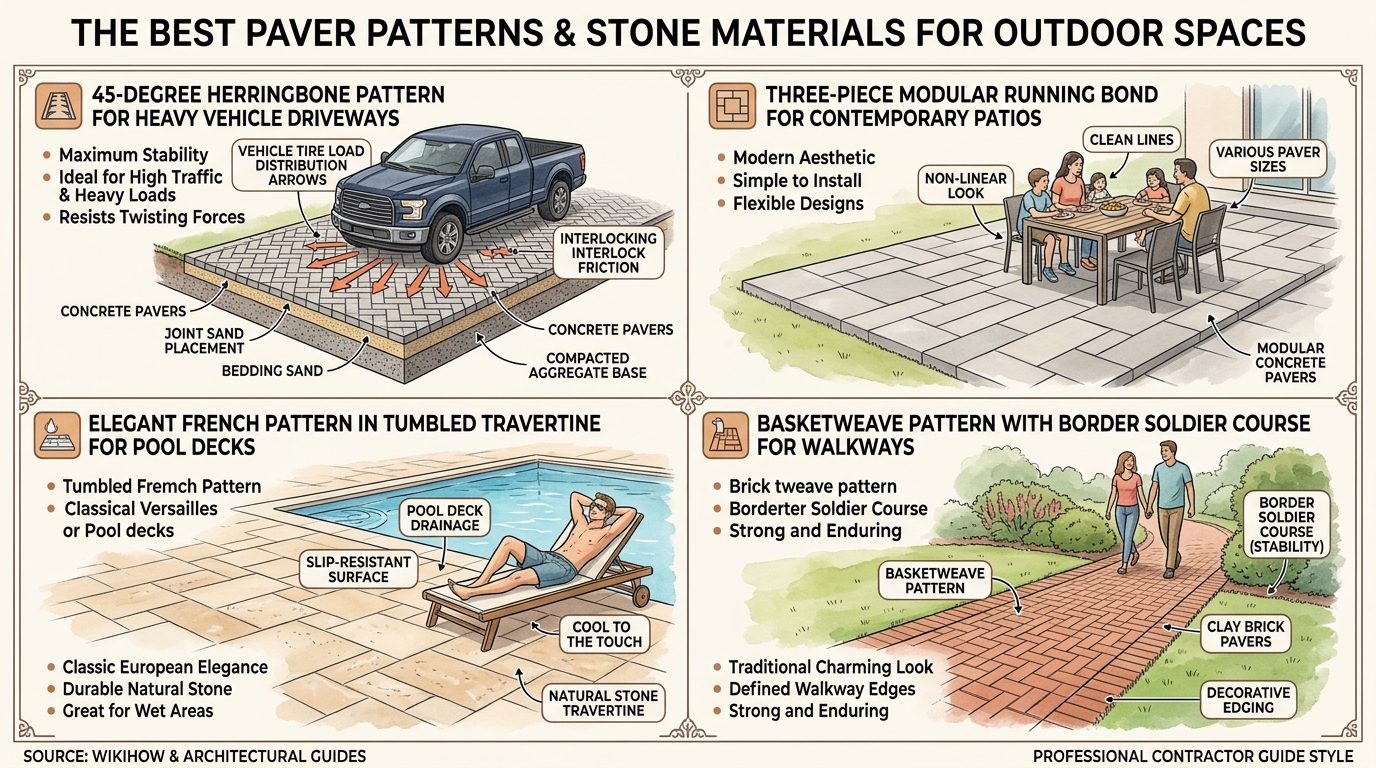
- 45-degree herringbone provides the strongest interlock for driveways, distributing tire acceleration and braking torque evenly across joints to prevent vehicle rutting.
- 3-piece modular ashlar running bond gives suburban backyards in Alpharetta and Johns Creek a modern, clean look while gracefully masking slight ground contours.
- French pattern tumbled travertine remains the premier choice for swimming pool decks in Sandy Springs and Roswell because it stays naturally cool under bare feet and resists chlorine.
- Soldier courses set against concrete edge restraints lock the outer perimeter of your hardscape to prevent lateral spreading on sloped Georgia clay lots.
- Permeable paver patterns help North Atlanta homeowners comply with municipal impervious surface coverage caps during HOA and city permit reviews.
When planning a new hardscape in Metro Atlanta, homeowners often spend weeks picking out stone colors and textures, only to treat the laying pattern as an afterthought. That is a costly mistake.
In reality, the way your pavers interlock determines whether your new interlocking driveway will hold up under 6,000-pound electric SUVs, or whether your backyard paver patio can gracefully absorb seasonal moisture shifts in dense North Georgia red clay.
Below, our master masonry team breaks down the structural mechanics, visual aesthetics, and cost realities of the most durable paver patterns and stone materials across Duluth, Alpharetta, Johns Creek, Roswell, Milton, and Buckhead.
1. The Driveway Champion: 45-Degree vs. 90-Degree Herringbone
For any surface carrying vehicular traffic, joint friction and interlock are everything. Whenever a car accelerates, turns its wheels while stationary, or comes to an abrupt stop, the tires transfer rotational torque directly into the surface stones.
- 45-Degree Herringbone (Highest Load Resistance): By laying rectangular pavers (like standard 4x8 Holland stone) at a 45-degree angle to the direction of vehicular travel, tire weight is distributed across both the length and width of multiple stones simultaneously. This prevents the formation of tire track ruts over time.
- 90-Degree Herringbone: Offers high interlocking strength similar to 45-degree, but aligns parallel with the driveway borders. It requires fewer diagonal cuts along straight edges, saving slightly on labor while maintaining heavy load ratings.
- Avoid Running Bond on Driveways: Straight running bond lines laid parallel to driving tracks allow tires to wedge individual rows forward over time, leading to joint separation and weed-friendly gaps.
Engineering Rule for Georgia Driveways
Never install pavers under 2-3/8 inches (60 mm) thick on residential driveways. For properties in Milton and Alpharetta that frequently accommodate commercial delivery trucks or heavy boat trailers, we specify 3-1/8 inch (80 mm) pavers over an 8 to 10-inch compacted crushed stone base.
2. Backyard Patios & Outdoor Living: The 3-Piece Modular Ashlar Pattern
While driveways demand high structural interlocking friction, backyard patios and dining areas prioritize visual flow, furniture stability, and comfort underfoot.
The most requested layout across suburban North Atlanta is the 3-piece modular ashlar running bond. This pattern combines three complementary sizes (typically large rectangles, medium squares, and small rectangles, such as Belgard Catalina or Tremron Templehurst):
- Eliminates Monotonous Grid Lines: By staggering different stone dimensions, the pattern eliminates long, uninterrupted joint seams. This creates a relaxed, upscale look reminiscent of European courtyard cobblestones.
- Hides Subgrade Tolerances: While our crews laser-level every aggregate base to precise 1/8-inch tolerances, Georgia red clay undergoes subtle sub-surface moisture changes. Multi-size modular patterns visually camouflage natural micro-settling far better than rigid large-format single-size tiles.
- Ideal for Outdoor Kitchens: The flat, smooth textured surfaces provide a rock-solid, wobble-free foundation for heavy dining tables, fire pit rings, and built-in masonry grill islands.
3. Pool Decks: French Versailles Pattern in Tumbled Travertine
Pool decks operate under very specific environmental stresses: constant water splashing, chlorine or saltwater exposure, direct summer sun, and bare human feet.
For swimming pool renovations in Sandy Springs, Roswell, and Johns Creek, our premier recommendation is natural tumbled travertine in a 4-size French (Versailles) pattern:
- Naturally Cool Underfoot: Poured concrete and dark composite pavers can easily reach 130°F on a Georgia July afternoon. Light-hued travertine (such as Ivory or Walnut) remains cool to the touch because its porous natural limestone structure breathes and reflects sunlight.
- Non-Slip Tumbled Texture: Tumbled travertine features softened edges and microscopic surface pores that provide natural wet traction without requiring abrasive anti-slip coatings.
- Chemical & Salt Water Resistance: Unlike concrete pavers which can degrade if unsealed saltwater splashes on them, dense natural travertine stands up to modern saltwater chlorination systems with minimal long-term maintenance.
| Pattern & Material | Best Application | Interlock Strength | Relative Cost / Sq Ft | Cuts & Waste % |
|---|---|---|---|---|
| 45° Herringbone (Concrete Pavers) | Driveways & Motor Courts | Maximum (Vehicular) | $18 – $28 | 10% – 12% |
| 3-Piece Modular Ashlar | Patios & Fire Pits | Moderate (Pedestrian) | $16 – $26 | 5% – 7% |
| French Versailles (Travertine) | Pool Decks & Verandas | Moderate (Barefoot Safe) | $24 – $38 | 8% – 10% |
| Soldier Course Border | Perimeter Edge Restraint | Structural Anchor | Included in Base | 5% |
| Permeable Herringbone | Strict HOA Impervious Caps | High (Eco-Drainage) | $22 – $32 | 8% – 10% |
4. The Unsung Hero: Soldier & Sailor Course Perimeter Borders
Every exceptional hardscape installation needs a defined border. Think of the border as a structural picture frame: it locks the internal pattern in place, conceals angled field cuts, and creates a clean transition between your pavers and lush Bermuda or Zoysia sod.
Soldier Course (Standing Tall)
Pavers are laid perpendicular to the edge, standing shoulder to shoulder. This is the most common perimeter pattern because it provides strong visual containment and creates a solid 8-inch barrier against lateral movement.
Sailor Course (Laid Lengthwise)
Pavers are laid end-to-end, parallel with the perimeter. This creates a narrower, sleeker border that looks great along winding garden pathways and curved pool coping.
Concrete Edge Restraints (The Hidden Backbone)
A pattern is only as strong as its boundary. On all sloped installations in Fulton and Gwinnett, we embed the outer soldier course into a troweled concrete haunch (hidden concrete toe kick) reinforced with heavy-duty snap-edge restraints and 10-inch steel spikes.
5. Permeable Patterns for Strict North Atlanta Lot Coverage Rules
If you live in Sandy Springs, Alpharetta, or City of Atlanta limits, you are likely aware of municipal impervious surface limits (often capped at 30% to 45% of total lot square footage).
Permeable Interlocking Concrete Paver (PICP) systems use specialized spacer tabs that leave 1/4-inch to 3/8-inch joint gaps. Filled with clean #8 or #89 granite chip stone instead of sand, these patterns allow torrential Georgia rainwater to filter straight into a subterranean gravel reservoir at over 50 inches per hour.
This permeable setup counts as 100% pervious surface with most building departments, allowing you to build the expansive pool deck or driveway you want without triggering expensive stormwater detention vaults or civil engineering fees.
Expert Planning Advice
Before ordering pallets of stone, request a 3D digital layout rendering. Seeing your actual home exterior paired with a 45-degree herringbone driveway or a French pattern travertine patio eliminates guesswork and speeds up your HOA review committee approval.
Ready to Plan Your Hardscape Project?
Whether you need an engineered herringbone driveway to replace cracked builder concrete in Duluth, or a resort-style travertine pool deck in Alpharetta, AGS Stones and Pavers brings master craftsmanship with zero subcontracting.
Call our Duluth office today at (678) 428-7630 or request a free on-site design consultation and itemized quote online.
Common Questions from Homeowners
What is the strongest paver pattern for an Atlanta driveway with heavy SUVs and trucks?
+
The 45-degree herringbone pattern is the undisputed gold standard for vehicular driveways. Because the rectangular pavers meet at alternating perpendicular angles, tire rotation, braking forces, and acceleration torque radiate in four directions simultaneously. This interlock prevents individual stones from sliding forward or creating wheel ruts in the sand bed.
Does the laying pattern change the total installation cost?
+
Yes, primarily due to diamond blade cutting labor and scrap material allowance. Patterns set at a 45-degree angle or multi-piece systems like French Versailles require precise angle cuts along all outer edges. Expect a 10% to 15% increase in cutting labor and require a 10% waste buffer compared to simple straight running bond patterns.
Which stone material stays coolest around swimming pools during hot Georgia summers?
+
Natural light-toned travertine in Ivory, Roman Light, or Silver stays noticeably cooler than dark concrete pavers or poured concrete slabs. Travertine naturally reflects solar heat and absorbs moisture beneath its surface, making it comfortable for bare feet even during humid 95-degree Atlanta afternoons.
Can I mix different paver sizes on an outdoor patio?
+
Yes. Three-piece and four-piece modular paver systems (such as 6x6, 6x9, and 9x9 inch stones) are the most requested patio style across North Fulton and Gwinnett. They eliminate continuous joint lines, creating a relaxed natural stone aesthetic that fits both traditional brick homes and modern farmhouse architecture.
Why do paver edges always have a different border pattern?
+
A perimeter border, typically laid as a soldier course (standing upright side-by-side) or sailor course (laid lengthwise), acts as a structural anchor. It creates a solid picture frame that hides field cuts, secures the perimeter against lateral creep, and rests directly against commercial edge restraints or hidden concrete toe kicks.
Ready to Start Your Project?
Our in-house crews design and build driveways, patios, retaining walls and outdoor kitchens across North Metro Atlanta.
4579 Abbotts Bridge Rd Suite 10, Duluth, GA 30097 • Mon–Fri: 8:00 AM – 6:00 PM
Explore Services & Local Pages
Related Services
Service Areas
More Guides
- → Can You Install Pavers in Winter in Georgia? Complete Cold-Weather Hardscape & Pricing Guide
- → How to Fix Backyard Drainage, Standing Water & Mud on Georgia Red Clay: French Drains, Swales & Hardscape Guide
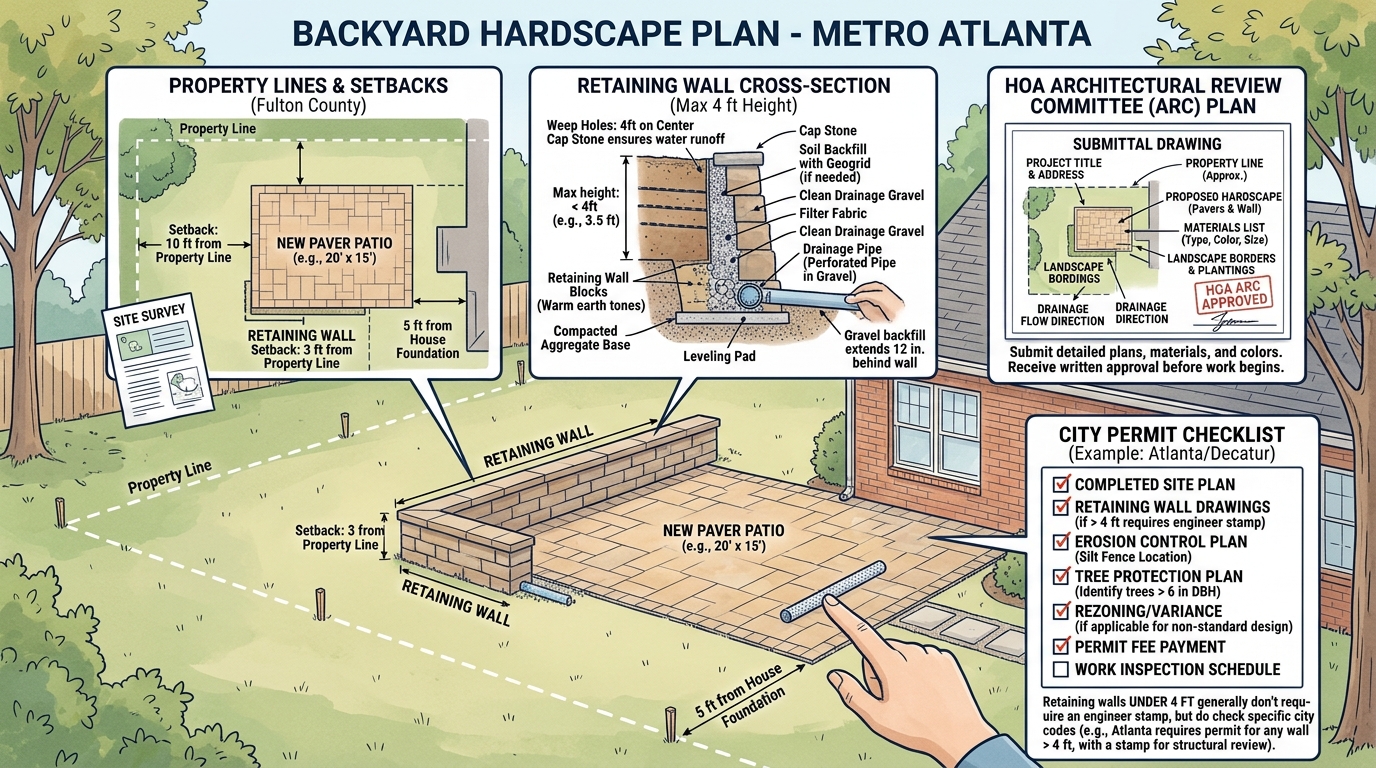
- → Do You Need a Permit for a Paver Patio, Retaining Wall or Driveway in Metro Atlanta? (City-by-City HOA & Code Guide)
- → How Much Do Pavers Cost in Atlanta? Patio, Driveway & Retaining Wall Pricing Guide
- → Pavers vs. Concrete Driveways in Georgia: Which Lasts Longer on Red Clay?
- → How to Clean and Seal Pavers: A Step-by-Step Maintenance Guide
- → Why Retaining Walls Fail in Georgia (and How to Build One That Lasts)
- → Travertine vs. Concrete Pavers for Pool Decks: Heat, Safety and Cost Compared
- → Planning an Outdoor Kitchen in Metro Atlanta: Layout, Materials and Budget
Related Guides
View All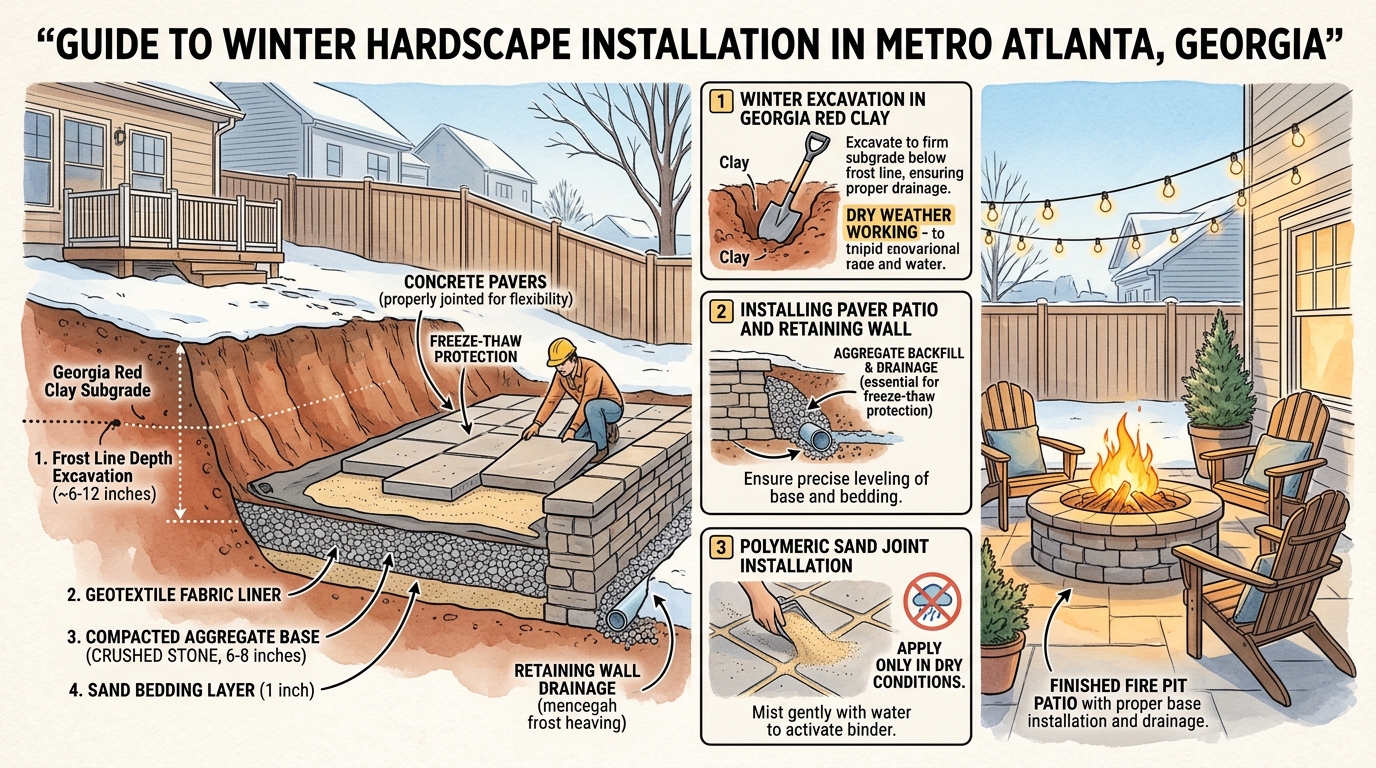
Can You Install Pavers in Winter in Georgia? Complete Cold-Weather Hardscape & Pricing Guide
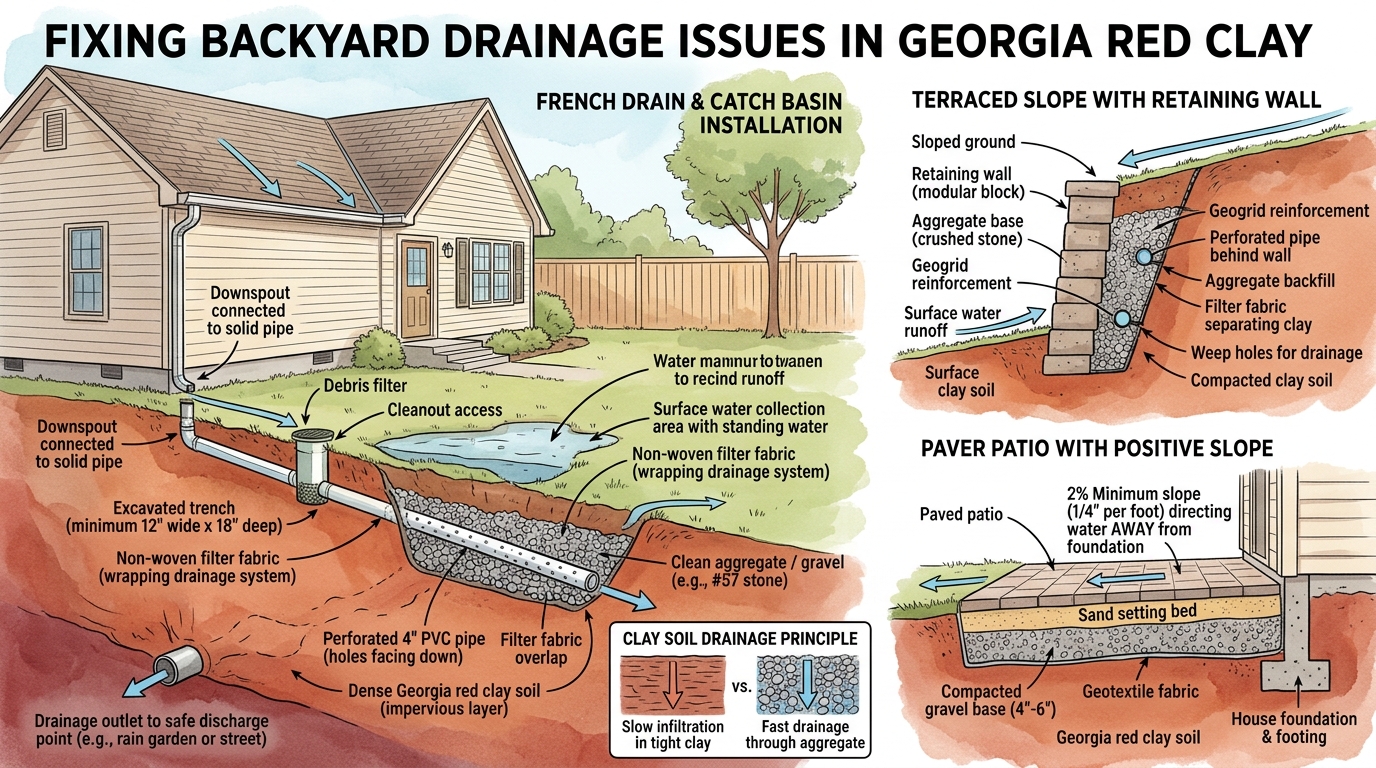
How to Fix Backyard Drainage, Standing Water & Mud on Georgia Red Clay: French Drains, Swales & Hardscape Guide